London
The Curious Incident of the Dog in the Night-TimeLondon becomes both the place where Christopher believes he can live with his mother and a demanding landscape he must learn to navigate alone. An address recovered from her letters gives him a destination; the journey there tests whether that knowledge can carry him through unfamiliar streets, crowded stations, and the Underground.
The Address and the Decision
The address Christopher finds in his mother’s letters is 451c Chapter Road, Willesden, London NW2 5NG. Its significance becomes clear when the postmark shows that a letter was sent on 16 October 1997, eighteen months after his mother was said to have died. Christopher considers whether someone else might have written it in her name, but the postmark makes the letters evidence that she is alive and in London.
After his father’s confession, Christopher weighs where he could go. He rules out living with Uncle Terry in Sunderland and with Mrs. Alexander, then concludes that his mother is the only family member whose address he knows. Going to London frightens him: he has never been there and has never travelled anywhere alone beyond the shop at the end of his road. Returning home or hiding nearby seems still more frightening, so he crosses those options out and settles on the journey.
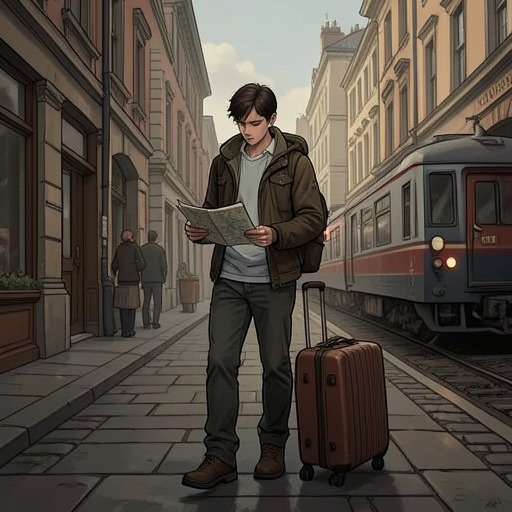
The address is not merely a destination but a piece of practical information that makes departure possible. Christopher knows how train travel works from his model railway: check the timetable, go to the station, buy a ticket, consult the departure board, and find the correct platform. He plans to leave from Swindon station, turning a remembered address and a familiar sequence of procedures into a route toward his mother.
The Railway Station as an Obstacle
At Swindon station, the actual building differs from the simple two-room station on Christopher’s train set. It has a tunnel, stairs, a shop, a café, and a waiting room. Because fear interferes with his attention, he recognizes that his map of it is only an approximation. The station feels like standing on a cliff in a strong wind: people stream through the echoing tunnel, the air smells of toilets and cigarettes, and the crush of sights and sounds makes him giddy and sick.
Christopher braces himself against a wall and grips the edge of a sign to keep from falling or crouching on the ground. He wants to go home but is afraid to do so; the competing demands leave him unable to plan. Covering his ears, he decides to walk down the tunnel in search of somewhere to sit and think, using a CCTV warning sign as a point of concentration. The passage offers no calm, but following a sign gives him one manageable task at a time.
At the far end, the first room with chairs is too crowded, so he continues to a quieter corner with an unoccupied table. There he closes his eyes, feeds Toby two pellets of rat food, and grips his Swiss Army knife in his other hand. He groans softly to mask the noise without drawing other people’s attention. When his thoughts remain too crowded to organize, he works through a mathematics problem to clear his head. The station is therefore not just a connection between towns: it is a place where movement depends on finding ways to regulate fear and narrow attention.
London’s Underground and the Route Through It
In London, a woman points Christopher toward the Underground and suggests either the Bakerloo Line to Willesden Junction or the Jubilee Line to Willesden Green. Christopher tells himself that he can manage and pictures the people around him as cows in a field. To cross the large room, he imagines a red line along the floor and follows it. He keeps the Swiss Army knife in one pocket and Toby in the other, holding on to the rat so it will not escape.
The escalators seem like a moving staircase from a science-fiction film, and their novelty makes him laugh, but he initially chooses the ordinary stairs. At the signs, he cannot find the Jubilee Line, so he revises the plan and selects Willesden Junction on the Bakerloo Line. He reads the station names, follows the left-pointing arrow through a tunnel divided by a fence, and keeps to the left as people approach from the other direction. A further sign sends him down an escalator; although he wants to hit the people standing close to him, he refrains because he remembers the police caution.
At the bottom, Christopher trips while jumping off and bumps into someone. He chooses the Northbound route because Willesden appears in the upper half of the map and the top of a map is north. The next station is small, windowless, and crowded, with curved walls covered in advertisements. He finds a seat at the end of a bench. Again, maps and signs supply a dependable order, but the stations themselves remain difficult spaces in which crowding and lack of windows affect what he can manage.
Arrival in Willesden
From Willesden Junction, Christopher follows the roads toward Chapter Road. He goes up a staircase, crosses a bridge, passes through a ticket gate, and emerges into the street. It is dark, with bright lights, and being outside after a long time makes him feel sick. He keeps his eyelids nearly closed and concentrates on the road shapes until he recognizes Station Approach and Oak Lane, the streets he needs.
The walk to 451c Chapter Road takes twenty-seven minutes. When Christopher presses the button for Flat C, no one is home. Along the way, he encounters eight men in Viking costumes shouting in the street; he notes that they are not real Vikings because Vikings lived nearly two thousand years earlier. He also urinates in an alley beside the closed Burdett Motors garage because he needs to go and does not want to wet himself again. The journey reaches its geographical endpoint, but not yet the reunion he seeks.
Narrative Significance
London is at once intimate and unfamiliar: it is home because Christopher has identified his mother’s address there, yet it is also roughly one hundred miles away and the first city he must navigate on his own. The journey converts distance into explicit decisions—an address, a train, signs, directions, and streets—rather than treating arrival as a simple leap from one place to another.
The contrast between the orderly diagrams Christopher relies on and the crowded, noisy stations he encounters gives London its particular narrative force. A map can tell him which way is north, and a sign can direct him to a line, but neither removes the bodily difficulty of moving through a tunnel full of people. His progress comes from repeatedly reducing a vast unfamiliar environment to the next readable instruction, carrying Toby and using familiar habits to keep moving toward his mother.